
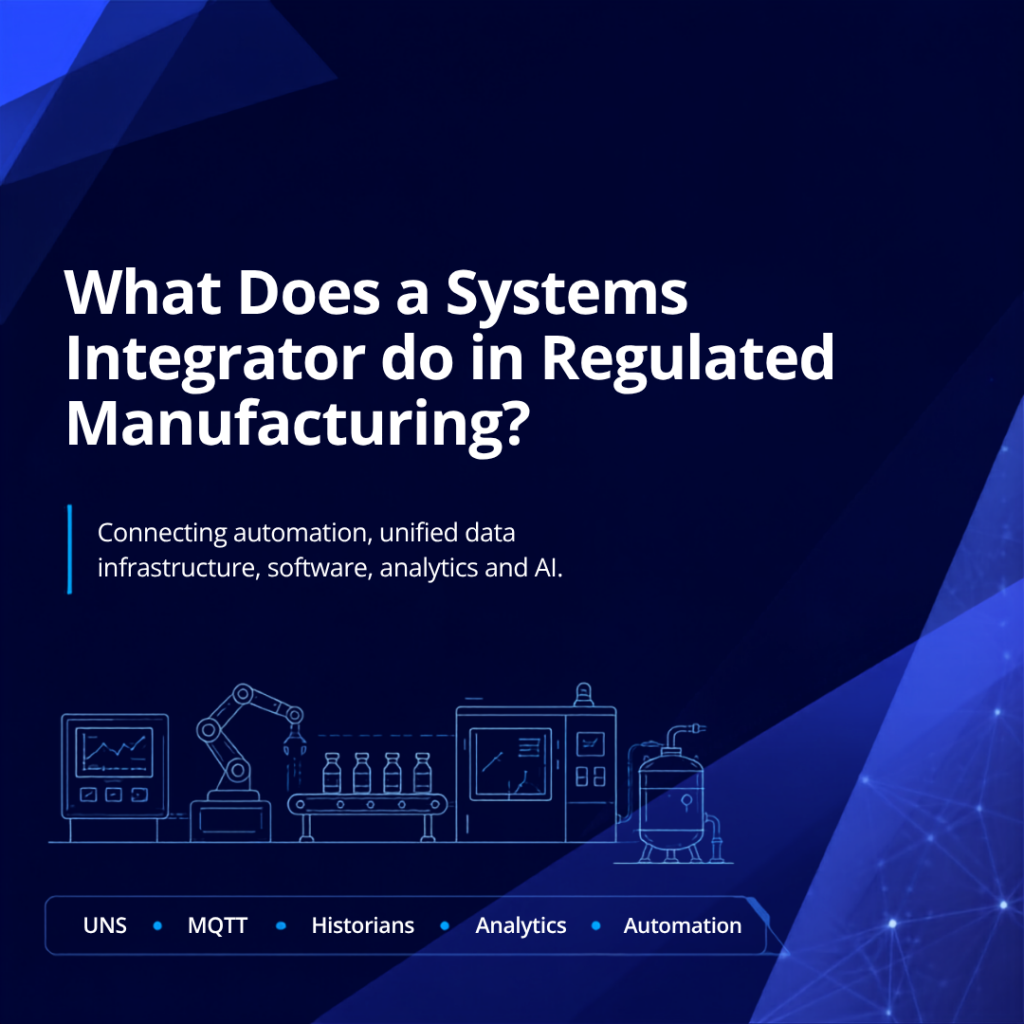
What does a systems integrator do in regulated manufacturing?
What does a systems integrator do in regulated manufacturing?
What Does a Systems Integrator Do in Regulated Manufacturing?
A systems integrator helps manufacturers connect, modernise and manage the technologies that control production and turn operational data into useful information. In regulated manufacturing, this includes automation, control systems, unified and scalable data infrastructure, Unified Namespace architectures, MQTT brokers, process historians, industrial software, analytics, IT/OT integration and validation, all delivered within the compliance requirements governing the facility.
For organisations operating in life sciences, pharmaceutical, biopharmaceutical, medical device, food and beverage and other regulated manufacturing environments, the role of the systems integrator has become increasingly important.
Modern manufacturing sites rarely operate on a single technology platform. Instead, they rely on a complex ecosystem of PLCs, SCADA systems, DCS platforms, process historians, industrial data platforms, software applications and enterprise systems.
The challenge is not simply deploying these technologies. It is ensuring they work together reliably, securely and compliantly.
That is where an experienced systems integrator adds value.
What is a systems integrator in manufacturing?
A manufacturing systems integrator brings different technologies, platforms and operational systems together into a connected manufacturing environment.
Rather than approaching automation, data and digitalisation as separate projects, a systems integrator looks at how the complete technology architecture supports the manufacturing process.
This can include:
- PLC, SCADA and DCS systems
- Automation and control system upgrades
- Unified Namespace architecture
- MQTT brokers and industrial messaging infrastructure
- Process and time-series historians
- Industrial data platforms
- IT and OT integration
- Manufacturing software development
- Data contextualisation
- Data analytics and reporting
- OT networks and cybersecurity
- Computer System Validation
- Compliance and data integrity
- Managed services and ongoing technical support
The objective is to create systems that are reliable today while also providing a scalable foundation for future manufacturing requirements.
What does a systems integrator actually do?
The exact scope will depend on the facility and project, but there are several areas where systems integrators play a particularly important role in regulated manufacturing.
1. Assess the existing manufacturing environment
Successful integration starts with understanding what is already in place.
Many established manufacturing sites contain technologies introduced over several decades. New platforms may operate alongside legacy PLCs, ageing control systems, different historian technologies and equipment supplied by multiple OEMs.
A systems integrator can assess the existing architecture to identify:
- Current automation and control systems
- Legacy infrastructure
- Data sources and interfaces
- Existing historian architecture
- IT and OT integration points
- Network dependencies
- System lifecycle risks
- Cybersecurity considerations
- Validation requirements
- Opportunities for consolidation or modernisation
This assessment helps organisations avoid making technology decisions in isolation.
Key takeaway
A systems integrator should understand the complete operational environment before recommending technology. The objective is not simply to replace systems, but to establish an architecture that supports manufacturing performance, compliance and long-term scalability.
2. Integrate automation and control systems
Automation remains at the centre of most manufacturing operations.
A systems integrator can design, implement and support environments incorporating technologies such as:
- PLCs
- SCADA
- DCS
- HMI systems
- Batch control systems
- OEM equipment
- Industrial networks
- Production line controls
Integration becomes especially important when multiple vendors or generations of technology are involved.
For example, a new production line may need to communicate with existing plant infrastructure while continuing to support older equipment elsewhere on the site.
The systems integrator provides the engineering expertise required to make these technologies operate as one coordinated environment.
3. Connect legacy systems with modern technologies
Replacing every legacy system is rarely realistic.
Manufacturing facilities frequently contain equipment that continues to perform its operational role effectively but was never designed to integrate with today’s digital infrastructure.
The challenge is finding a reliable way to connect those systems without unnecessarily disrupting production.
A systems integrator can develop an architecture that allows manufacturers to modernise gradually by connecting legacy technology to newer control, data and analytics platforms.
This can help extend the useful life of existing assets while reducing the risks associated with large-scale replacement programmes.
For multi-site manufacturers, this can become particularly important when attempting to create common technology or data standards across facilities with very different installed bases.
4. Design and implement manufacturing data infrastructure
Manufacturing organisations are generating more operational data than ever before.
The value of that information depends on whether it can be collected, structured, contextualised and made accessible.
A systems integrator can help manufacturers design the infrastructure required to move operational data from the plant floor into a unified, scalable data architecture that can include Unified Namespace environments, MQTT brokers, process historians, industrial data platforms, analytics and reporting systems.
This may include:
- Unified Namespace architecture and implementation
- MQTT brokers and publish/subscribe data architectures
- Process historian architecture
- Historian upgrades and migrations
- Industrial data platforms
- Data collection and interfaces
- Data contextualisation
- Tag structures and naming standards
- Data models and templates
- IT/OT data integration
- Data visualisation
- Reporting infrastructure
- Multi-site data strategies
The most effective modern architectures do not rely on a historian alone. Historians remain critically important for trusted time-series data, but technologies such as Unified Namespace architectures and MQTT brokers can create a more flexible way to move, contextualise and distribute manufacturing information across systems and sites.
The result should be more than a large repository of information.
A well-designed data architecture should help users understand what is happening across manufacturing operations and provide a trusted foundation for reporting, analytics and future AI applications.
Questions manufacturers should consider
When reviewing manufacturing data infrastructure, organisations should ask:
- Are we collecting the right operational data?
- Can teams easily access and understand that information?
- Is data structured consistently across equipment and sites?
- Are systems sharing data through a scalable architecture, or are we relying on large numbers of point-to-point integrations?
- Are legacy historian systems creating lifecycle risks?
- Could technologies such as MQTT and a Unified Namespace improve interoperability across our environment?
- Can our current architecture scale with future requirements?
- Is the data sufficiently contextualised for analytics and AI?
These questions increasingly form part of wider digital manufacturing strategies.
5. Upgrade and manage process historian systems
Process historians often become some of the most important systems within a manufacturing facility.
They may support production reporting, investigations, process optimisation, batch analysis and regulatory activities.
As these platforms age, manufacturers may encounter unsupported operating systems, ageing hardware, outdated software versions or increasingly complex interfaces.
Historian upgrades can therefore involve considerably more than installing a new version of software.
A systems integrator may need to manage:
- Infrastructure assessment
- Upgrade architecture
- Interface migration
- Historical data preservation
- Validation
- System cutover
- Data availability
- Cybersecurity
- Business continuity
- Long-term lifecycle planning
For regulated manufacturers, maintaining data integrity throughout this process is critical.
Réalta Technologies has delivered PI System upgrade programmes involving more than 50 interfaces, achieving zero data loss while completing validation within the required shutdown period.
That type of project demonstrates why historian modernisation requires expertise across engineering, infrastructure, data and compliance rather than treating the historian as an isolated software platform.
Historian strategy should also be considered as part of the wider manufacturing data architecture. Depending on the organisation’s requirements, this can mean integrating the historian with MQTT brokers, Unified Namespace environments, industrial data platforms and analytics tools rather than treating it as an isolated system.
This allows manufacturers to retain the reliability and depth of a process historian while creating a more scalable architecture for distributing operational data across the enterprise.
6. Integrate IT and OT environments
Historically, Operational Technology and Information Technology were often managed as separate environments.
Digital manufacturing increasingly requires them to work together.
Operational data may need to move securely between control systems, historian platforms, MQTT brokers, Unified Namespace architectures, historians, industrial data platforms, analytics applications, reporting tools and wider enterprise infrastructure.
A systems integrator helps design the interfaces between these environments while considering:
- System availability
- Data integrity
- Network architecture
- Cybersecurity
- User access
- Performance
- Scalability
- Compliance
Where appropriate, publish/subscribe architectures can also reduce dependence on complex point-to-point integrations and provide a more scalable approach to moving industrial data between systems.
The goal should not be connectivity for its own sake.
Every integration should have a defined operational or business purpose.
7. Support validation and regulatory compliance
Regulated manufacturing introduces additional responsibilities that do not exist in many conventional industrial environments.
Technology changes may affect validated processes, electronic records, data integrity and regulatory compliance.
An experienced systems integrator must therefore understand requirements such as:
- GxP
- GAMP 5 principles
- EU GMP Annex 11
- FDA 21 CFR Part 11
- Computer System Validation
- Data integrity
- Change control
- Documentation
- Traceability
Compliance should be considered during design rather than added at the end of a project.
This is particularly important when upgrading critical manufacturing infrastructure.
Architecture decisions, testing strategies, documentation and project execution should all support the organisation’s validation requirements.
Key takeaway
In regulated manufacturing, technical success and compliance cannot be separated. A system that performs technically but cannot meet validation or data-integrity requirements is not a successful implementation.
8. Turn operational data into actionable information
Connecting systems is only part of the challenge.
Manufacturers increasingly want to use their operational information to improve decision-making.
A systems integrator can help establish the data and analytics architecture required for applications including:
- Process performance analysis
- Golden batch analysis
- Operational dashboards
- Exception review
- Predictive analytics
- Equipment monitoring
- Process optimisation
- Root-cause analysis
- Advanced analytics
- AI applications
The most successful projects begin with a clear business or operational question rather than simply introducing another technology platform.
For example:
Where are production losses occurring?
Why does one batch perform differently from another?
Which equipment conditions indicate an increased risk of failure?
How can engineers investigate deviations more quickly?
Once the required outcome is understood, the appropriate data architecture can be designed around it.
9. Create a foundation for AI in manufacturing
Artificial intelligence is becoming increasingly relevant across industrial operations, but AI effectiveness depends heavily on the quality and structure of the underlying operational data.
Manufacturers considering AI should first assess whether they have:
- Reliable source data
- Appropriate historian coverage
- Consistent data structures
- A scalable industrial data architecture
- Consistent data distribution between systems
- Appropriate MQTT and Unified Namespace capabilities where required
- Contextualised information
- Strong IT/OT integration
- Scalable data infrastructure
- Defined governance
- Suitable analytics capabilities
A systems integrator can help build these foundations before organisations move into more advanced AI use cases.
For many manufacturers, AI readiness is therefore not simply a question of selecting an AI platform. It requires a strong underlying architecture connecting automation systems, historians, Unified Namespace environments, MQTT brokers, data platforms and analytics technologies.
Without them, AI programmes can struggle to move beyond proof-of-concept projects.
10. Deliver complex projects across multiple technologies and sites
Large manufacturing programmes frequently involve several disciplines simultaneously.
An automation upgrade could affect networking, servers, historian interfaces, validation, reporting systems and existing production equipment.
Multi-site programmes add another level of complexity.
A systems integrator can coordinate these elements within one delivery model, while establishing common approaches to automation, data models, historian infrastructure, MQTT architectures, Unified Namespace standards and analytics across sites..
Réalta Technologies has supported global pharmaceutical programmes involving approximately 70,000 historian tags, 185 networked assets and integration with approximately 180 legacy PLCs and control systems across three manufacturing sites.
Projects of this scale require more than individual technical specialists. They require a structured approach to architecture, project delivery, standardisation, testing, validation and stakeholder management.
11. Provide lifecycle management and ongoing support
Manufacturing systems do not stop changing once a project is commissioned.
Operating systems reach end of support. Software platforms release new versions. Cybersecurity requirements evolve. Equipment changes. Production expands.
A systems integrator can therefore remain involved throughout the system lifecycle.
Support can include:
- Preventative maintenance
- System health checks
- Technical troubleshooting
- Software upgrades
- Infrastructure modernisation
- Historian lifecycle management
- Cybersecurity reviews
- Performance optimisation
- Managed services
- Project support
- Engineering resources
This lifecycle approach can help manufacturers identify risks before systems become obsolete or unsupported.
Why is systems integration particularly important in regulated manufacturing?
Regulated manufacturers face a combination of technical and compliance requirements that make system changes particularly complex.
Production systems need to be:
Reliable
Manufacturing operations cannot tolerate unnecessary downtime.
Compliant
Systems and processes must support applicable regulatory requirements.
Validated
Changes to regulated systems need appropriate testing, documentation and traceability.
Secure
Increasing connectivity must be accompanied by appropriate OT cybersecurity controls.
Scalable
Technology architecture should support future production, sites and digitalisation initiatives.
Maintainable
Manufacturers need to understand how systems will be supported throughout their lifecycle.
A systems integrator brings these considerations together rather than solving each problem independently.
When should a manufacturer engage a systems integrator?
A systems integrator can add value at many stages of the manufacturing technology lifecycle.
Common triggers include:
- Building a new manufacturing facility
- Introducing new production equipment
- Modernising legacy automation
- Upgrading PLC, SCADA or DCS infrastructure
- Upgrading a process historian
- Developing a manufacturing data strategy
- Connecting previously isolated operational systems
- Standardising technologies across multiple sites
- Improving access to operational data
- Preparing manufacturing data for analytics or AI
- Addressing system obsolescence
- Strengthening OT cybersecurity
- Implementing validated system changes
- Establishing long-term managed support
Engaging an integrator early can often reduce project risk because architecture, integration, compliance and lifecycle considerations can be addressed before major technology decisions are made.
What should you look for in a systems integrator?
For regulated manufacturing environments, manufacturers should assess more than technical familiarity with an individual platform.
Look for a partner with proven capability across:
- Regulated manufacturing experience
Understanding the realities of operating within GxP and other regulated environments. - Automation expertise
Capability across PLC, SCADA, DCS, controls and industrial networking. - Modern data infrastructure experience
Knowledge of Unified Namespace architecture, MQTT brokers, process historians, industrial data platforms, contextualisation, data modelling and IT/OT integration. The integrator should understand how these technologies work together rather than approaching each as a standalone platform.
- Validation capability
Experience delivering systems within appropriate compliance and validation frameworks. - Cybersecurity awareness
Understanding how increased manufacturing connectivity affects OT risk. - Multi-technology expertise
The ability to integrate different technology platforms rather than forcing every challenge into one solution. - Lifecycle support
A delivery model that extends beyond project commissioning. - Global delivery capability
Particularly important for manufacturers operating across multiple facilities and regions.
Why work with Réalta Technologies?
Réalta Technologies provides systems integration services across automation, data infrastructure, analytics, software, validation and managed support for life sciences and regulated manufacturing organisations.
Our teams support projects across Ireland, Europe, the United States and India, combining local engineering capability with international project delivery.
Réalta Technologies works across a broad ecosystem of leading industrial automation, data infrastructure and analytics technologies. Our technology partnerships and system integration capabilities include:
- AVEVA PI Endorsed System Integrator
- Ignition System Integrator
- HighByte System Integrator
- Canary System Integrator
- Seeq Partner
- Databricks
- HiveMQ
Réalta Technologies is also an AVEVA PI Endorsed System Integrator, with experience delivering complex historian implementations, upgrades and global data infrastructure programmes.
Our approach brings together:
- Advanced Automation
- Digital Transformation
- AI & Advanced Analytics
- Software Development
- Compliance, Validation & Quality
- Managed Services & Support
Rather than viewing these disciplines independently, Réalta Technologies helps manufacturers build connected technology environments designed around operational requirements, compliance and long-term scalability.
The key takeaway
A systems integrator does much more than connect different pieces of technology.
In regulated manufacturing, the systems integrator helps organisations create reliable, compliant and scalable environments connecting automation, operational data, software, analytics and infrastructure.
The right integration strategy can help manufacturers modernise legacy technologies, improve visibility, reduce technology risk, strengthen compliance and establish the foundations required for future digital manufacturing and AI initiatives.
If your organisation is reviewing its automation environment, historian architecture, operational data strategy or wider digital manufacturing roadmap, talk to Réalta Technologies about how we can support your next project.
💻 https://realtatechnologies.com
📞 IRL: +353 21 243 9113 | US: +1 302 509 4401

What does a systems integrator do in regulated manufacturing?
What does a systems integrator actually do in a regulated manufacturing environment? We explore the role across automation, operational data infrastructure, analytics, testing, lifecycle management

How to Choose a Life Science System Integrator Partner
Choosing the right pharmaceutical automation partner requires more than comparing technology and costs. This guide explains how manufacturers in Ireland, the EU and the US
Benefits of Project management when deploying GXP applications in highly regulated manufacturing environment
Manufacturing projects involve multiple stakeholders, complex technologies and strict timelines. Discover how an end-to-end project management service helps reduce risk, improve collaboration and deliver successful
What does a systems integrator do in regulated manufacturing?
What Does a Systems Integrator Do in Regulated Manufacturing?
A systems integrator helps manufacturers connect, modernise and manage the technologies that control production and turn operational data into useful information. In regulated manufacturing, this includes automation, control systems, unified and scalable data infrastructure, Unified Namespace architectures, MQTT brokers, process historians, industrial software, analytics, IT/OT integration and validation, all delivered within the compliance requirements governing the facility.
For organisations operating in life sciences, pharmaceutical, biopharmaceutical, medical device, food and beverage and other regulated manufacturing environments, the role of the systems integrator has become increasingly important.
Modern manufacturing sites rarely operate on a single technology platform. Instead, they rely on a complex ecosystem of PLCs, SCADA systems, DCS platforms, process historians, industrial data platforms, software applications and enterprise systems.
The challenge is not simply deploying these technologies. It is ensuring they work together reliably, securely and compliantly.
That is where an experienced systems integrator adds value.
What is a systems integrator in manufacturing?
A manufacturing systems integrator brings different technologies, platforms and operational systems together into a connected manufacturing environment.
Rather than approaching automation, data and digitalisation as separate projects, a systems integrator looks at how the complete technology architecture supports the manufacturing process.
This can include:
- PLC, SCADA and DCS systems
- Automation and control system upgrades
- Unified Namespace architecture
- MQTT brokers and industrial messaging infrastructure
- Process and time-series historians
- Industrial data platforms
- IT and OT integration
- Manufacturing software development
- Data contextualisation
- Data analytics and reporting
- OT networks and cybersecurity
- Computer System Validation
- Compliance and data integrity
- Managed services and ongoing technical support
The objective is to create systems that are reliable today while also providing a scalable foundation for future manufacturing requirements.
What does a systems integrator actually do?
The exact scope will depend on the facility and project, but there are several areas where systems integrators play a particularly important role in regulated manufacturing.
1. Assess the existing manufacturing environment
Successful integration starts with understanding what is already in place.
Many established manufacturing sites contain technologies introduced over several decades. New platforms may operate alongside legacy PLCs, ageing control systems, different historian technologies and equipment supplied by multiple OEMs.
A systems integrator can assess the existing architecture to identify:
- Current automation and control systems
- Legacy infrastructure
- Data sources and interfaces
- Existing historian architecture
- IT and OT integration points
- Network dependencies
- System lifecycle risks
- Cybersecurity considerations
- Validation requirements
- Opportunities for consolidation or modernisation
This assessment helps organisations avoid making technology decisions in isolation.
Key takeaway
A systems integrator should understand the complete operational environment before recommending technology. The objective is not simply to replace systems, but to establish an architecture that supports manufacturing performance, compliance and long-term scalability.
2. Integrate automation and control systems
Automation remains at the centre of most manufacturing operations.
A systems integrator can design, implement and support environments incorporating technologies such as:
- PLCs
- SCADA
- DCS
- HMI systems
- Batch control systems
- OEM equipment
- Industrial networks
- Production line controls
Integration becomes especially important when multiple vendors or generations of technology are involved.
For example, a new production line may need to communicate with existing plant infrastructure while continuing to support older equipment elsewhere on the site.
The systems integrator provides the engineering expertise required to make these technologies operate as one coordinated environment.
3. Connect legacy systems with modern technologies
Replacing every legacy system is rarely realistic.
Manufacturing facilities frequently contain equipment that continues to perform its operational role effectively but was never designed to integrate with today’s digital infrastructure.
The challenge is finding a reliable way to connect those systems without unnecessarily disrupting production.
A systems integrator can develop an architecture that allows manufacturers to modernise gradually by connecting legacy technology to newer control, data and analytics platforms.
This can help extend the useful life of existing assets while reducing the risks associated with large-scale replacement programmes.
For multi-site manufacturers, this can become particularly important when attempting to create common technology or data standards across facilities with very different installed bases.
4. Design and implement manufacturing data infrastructure
Manufacturing organisations are generating more operational data than ever before.
The value of that information depends on whether it can be collected, structured, contextualised and made accessible.
A systems integrator can help manufacturers design the infrastructure required to move operational data from the plant floor into a unified, scalable data architecture that can include Unified Namespace environments, MQTT brokers, process historians, industrial data platforms, analytics and reporting systems.
This may include:
- Unified Namespace architecture and implementation
- MQTT brokers and publish/subscribe data architectures
- Process historian architecture
- Historian upgrades and migrations
- Industrial data platforms
- Data collection and interfaces
- Data contextualisation
- Tag structures and naming standards
- Data models and templates
- IT/OT data integration
- Data visualisation
- Reporting infrastructure
- Multi-site data strategies
The most effective modern architectures do not rely on a historian alone. Historians remain critically important for trusted time-series data, but technologies such as Unified Namespace architectures and MQTT brokers can create a more flexible way to move, contextualise and distribute manufacturing information across systems and sites.
The result should be more than a large repository of information.
A well-designed data architecture should help users understand what is happening across manufacturing operations and provide a trusted foundation for reporting, analytics and future AI applications.
Questions manufacturers should consider
When reviewing manufacturing data infrastructure, organisations should ask:
- Are we collecting the right operational data?
- Can teams easily access and understand that information?
- Is data structured consistently across equipment and sites?
- Are systems sharing data through a scalable architecture, or are we relying on large numbers of point-to-point integrations?
- Are legacy historian systems creating lifecycle risks?
- Could technologies such as MQTT and a Unified Namespace improve interoperability across our environment?
- Can our current architecture scale with future requirements?
- Is the data sufficiently contextualised for analytics and AI?
These questions increasingly form part of wider digital manufacturing strategies.
5. Upgrade and manage process historian systems
Process historians often become some of the most important systems within a manufacturing facility.
They may support production reporting, investigations, process optimisation, batch analysis and regulatory activities.
As these platforms age, manufacturers may encounter unsupported operating systems, ageing hardware, outdated software versions or increasingly complex interfaces.
Historian upgrades can therefore involve considerably more than installing a new version of software.
A systems integrator may need to manage:
- Infrastructure assessment
- Upgrade architecture
- Interface migration
- Historical data preservation
- Validation
- System cutover
- Data availability
- Cybersecurity
- Business continuity
- Long-term lifecycle planning
For regulated manufacturers, maintaining data integrity throughout this process is critical.
Réalta Technologies has delivered PI System upgrade programmes involving more than 50 interfaces, achieving zero data loss while completing validation within the required shutdown period.
That type of project demonstrates why historian modernisation requires expertise across engineering, infrastructure, data and compliance rather than treating the historian as an isolated software platform.
Historian strategy should also be considered as part of the wider manufacturing data architecture. Depending on the organisation’s requirements, this can mean integrating the historian with MQTT brokers, Unified Namespace environments, industrial data platforms and analytics tools rather than treating it as an isolated system.
This allows manufacturers to retain the reliability and depth of a process historian while creating a more scalable architecture for distributing operational data across the enterprise.
6. Integrate IT and OT environments
Historically, Operational Technology and Information Technology were often managed as separate environments.
Digital manufacturing increasingly requires them to work together.
Operational data may need to move securely between control systems, historian platforms, MQTT brokers, Unified Namespace architectures, historians, industrial data platforms, analytics applications, reporting tools and wider enterprise infrastructure.
A systems integrator helps design the interfaces between these environments while considering:
- System availability
- Data integrity
- Network architecture
- Cybersecurity
- User access
- Performance
- Scalability
- Compliance
Where appropriate, publish/subscribe architectures can also reduce dependence on complex point-to-point integrations and provide a more scalable approach to moving industrial data between systems.
The goal should not be connectivity for its own sake.
Every integration should have a defined operational or business purpose.
7. Support validation and regulatory compliance
Regulated manufacturing introduces additional responsibilities that do not exist in many conventional industrial environments.
Technology changes may affect validated processes, electronic records, data integrity and regulatory compliance.
An experienced systems integrator must therefore understand requirements such as:
- GxP
- GAMP 5 principles
- EU GMP Annex 11
- FDA 21 CFR Part 11
- Computer System Validation
- Data integrity
- Change control
- Documentation
- Traceability
Compliance should be considered during design rather than added at the end of a project.
This is particularly important when upgrading critical manufacturing infrastructure.
Architecture decisions, testing strategies, documentation and project execution should all support the organisation’s validation requirements.
Key takeaway
In regulated manufacturing, technical success and compliance cannot be separated. A system that performs technically but cannot meet validation or data-integrity requirements is not a successful implementation.
8. Turn operational data into actionable information
Connecting systems is only part of the challenge.
Manufacturers increasingly want to use their operational information to improve decision-making.
A systems integrator can help establish the data and analytics architecture required for applications including:
- Process performance analysis
- Golden batch analysis
- Operational dashboards
- Exception review
- Predictive analytics
- Equipment monitoring
- Process optimisation
- Root-cause analysis
- Advanced analytics
- AI applications
The most successful projects begin with a clear business or operational question rather than simply introducing another technology platform.
For example:
Where are production losses occurring?
Why does one batch perform differently from another?
Which equipment conditions indicate an increased risk of failure?
How can engineers investigate deviations more quickly?
Once the required outcome is understood, the appropriate data architecture can be designed around it.
9. Create a foundation for AI in manufacturing
Artificial intelligence is becoming increasingly relevant across industrial operations, but AI effectiveness depends heavily on the quality and structure of the underlying operational data.
Manufacturers considering AI should first assess whether they have:
- Reliable source data
- Appropriate historian coverage
- Consistent data structures
- A scalable industrial data architecture
- Consistent data distribution between systems
- Appropriate MQTT and Unified Namespace capabilities where required
- Contextualised information
- Strong IT/OT integration
- Scalable data infrastructure
- Defined governance
- Suitable analytics capabilities
A systems integrator can help build these foundations before organisations move into more advanced AI use cases.
For many manufacturers, AI readiness is therefore not simply a question of selecting an AI platform. It requires a strong underlying architecture connecting automation systems, historians, Unified Namespace environments, MQTT brokers, data platforms and analytics technologies.
Without them, AI programmes can struggle to move beyond proof-of-concept projects.
10. Deliver complex projects across multiple technologies and sites
Large manufacturing programmes frequently involve several disciplines simultaneously.
An automation upgrade could affect networking, servers, historian interfaces, validation, reporting systems and existing production equipment.
Multi-site programmes add another level of complexity.
A systems integrator can coordinate these elements within one delivery model, while establishing common approaches to automation, data models, historian infrastructure, MQTT architectures, Unified Namespace standards and analytics across sites..
Réalta Technologies has supported global pharmaceutical programmes involving approximately 70,000 historian tags, 185 networked assets and integration with approximately 180 legacy PLCs and control systems across three manufacturing sites.
Projects of this scale require more than individual technical specialists. They require a structured approach to architecture, project delivery, standardisation, testing, validation and stakeholder management.
11. Provide lifecycle management and ongoing support
Manufacturing systems do not stop changing once a project is commissioned.
Operating systems reach end of support. Software platforms release new versions. Cybersecurity requirements evolve. Equipment changes. Production expands.
A systems integrator can therefore remain involved throughout the system lifecycle.
Support can include:
- Preventative maintenance
- System health checks
- Technical troubleshooting
- Software upgrades
- Infrastructure modernisation
- Historian lifecycle management
- Cybersecurity reviews
- Performance optimisation
- Managed services
- Project support
- Engineering resources
This lifecycle approach can help manufacturers identify risks before systems become obsolete or unsupported.
Why is systems integration particularly important in regulated manufacturing?
Regulated manufacturers face a combination of technical and compliance requirements that make system changes particularly complex.
Production systems need to be:
Reliable
Manufacturing operations cannot tolerate unnecessary downtime.
Compliant
Systems and processes must support applicable regulatory requirements.
Validated
Changes to regulated systems need appropriate testing, documentation and traceability.
Secure
Increasing connectivity must be accompanied by appropriate OT cybersecurity controls.
Scalable
Technology architecture should support future production, sites and digitalisation initiatives.
Maintainable
Manufacturers need to understand how systems will be supported throughout their lifecycle.
A systems integrator brings these considerations together rather than solving each problem independently.
When should a manufacturer engage a systems integrator?
A systems integrator can add value at many stages of the manufacturing technology lifecycle.
Common triggers include:
- Building a new manufacturing facility
- Introducing new production equipment
- Modernising legacy automation
- Upgrading PLC, SCADA or DCS infrastructure
- Upgrading a process historian
- Developing a manufacturing data strategy
- Connecting previously isolated operational systems
- Standardising technologies across multiple sites
- Improving access to operational data
- Preparing manufacturing data for analytics or AI
- Addressing system obsolescence
- Strengthening OT cybersecurity
- Implementing validated system changes
- Establishing long-term managed support
Engaging an integrator early can often reduce project risk because architecture, integration, compliance and lifecycle considerations can be addressed before major technology decisions are made.
What should you look for in a systems integrator?
For regulated manufacturing environments, manufacturers should assess more than technical familiarity with an individual platform.
Look for a partner with proven capability across:
- Regulated manufacturing experience
Understanding the realities of operating within GxP and other regulated environments. - Automation expertise
Capability across PLC, SCADA, DCS, controls and industrial networking. - Modern data infrastructure experience
Knowledge of Unified Namespace architecture, MQTT brokers, process historians, industrial data platforms, contextualisation, data modelling and IT/OT integration. The integrator should understand how these technologies work together rather than approaching each as a standalone platform.
- Validation capability
Experience delivering systems within appropriate compliance and validation frameworks. - Cybersecurity awareness
Understanding how increased manufacturing connectivity affects OT risk. - Multi-technology expertise
The ability to integrate different technology platforms rather than forcing every challenge into one solution. - Lifecycle support
A delivery model that extends beyond project commissioning. - Global delivery capability
Particularly important for manufacturers operating across multiple facilities and regions.
Why work with Réalta Technologies?
Réalta Technologies provides systems integration services across automation, data infrastructure, analytics, software, validation and managed support for life sciences and regulated manufacturing organisations.
Our teams support projects across Ireland, Europe, the United States and India, combining local engineering capability with international project delivery.
Réalta Technologies works across a broad ecosystem of leading industrial automation, data infrastructure and analytics technologies. Our technology partnerships and system integration capabilities include:
- AVEVA PI Endorsed System Integrator
- Ignition System Integrator
- HighByte System Integrator
- Canary System Integrator
- Seeq Partner
- Databricks
- HiveMQ
Réalta Technologies is also an AVEVA PI Endorsed System Integrator, with experience delivering complex historian implementations, upgrades and global data infrastructure programmes.
Our approach brings together:
- Advanced Automation
- Digital Transformation
- AI & Advanced Analytics
- Software Development
- Compliance, Validation & Quality
- Managed Services & Support
Rather than viewing these disciplines independently, Réalta Technologies helps manufacturers build connected technology environments designed around operational requirements, compliance and long-term scalability.
The key takeaway
A systems integrator does much more than connect different pieces of technology.
In regulated manufacturing, the systems integrator helps organisations create reliable, compliant and scalable environments connecting automation, operational data, software, analytics and infrastructure.
The right integration strategy can help manufacturers modernise legacy technologies, improve visibility, reduce technology risk, strengthen compliance and establish the foundations required for future digital manufacturing and AI initiatives.
If your organisation is reviewing its automation environment, historian architecture, operational data strategy or wider digital manufacturing roadmap, talk to Réalta Technologies about how we can support your next project.
💻 https://realtatechnologies.com
📞 IRL: +353 21 243 9113 | US: +1 302 509 4401
What does a systems integrator do in regulated manufacturing?
What does a systems integrator actually do in a regulated manufacturing environment? We explore the role across automation, operational data infrastructure, analytics, testing, lifecycle management
How to Choose a Life Science System Integrator Partner
Choosing the right pharmaceutical automation partner requires more than comparing technology and costs. This guide explains how manufacturers in Ireland, the EU and the US
Benefits of Project management when deploying GXP applications in highly regulated manufacturing environment
Manufacturing projects involve multiple stakeholders, complex technologies and strict timelines. Discover how an end-to-end project management service helps reduce risk, improve collaboration and deliver successful
What does a systems integrator do in regulated manufacturing? Read More »

